
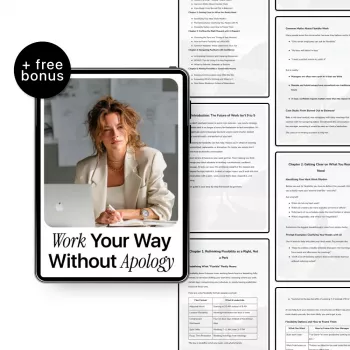
Flexible work shouldn’t require a personal confession or a perfect excuse. Our team created “Work Your Way Without Apology” for the real moment people get stuck: asking for a schedule change without sounding uncertain, oversharing, or risking career momentum. Inside, AI becomes the tool that helps you shape a clear ask, back it with outcomes your manager cares about, and prepare for pushback—so the conversation stays professional, measurable, and centered on performance.
If you’re good at your job but your current hours are no longer sustainable, you’re not alone—and you don’t need to “earn” flexibility through guilt or exhaustion. This guide is built for:
When you can state what you need and how it protects results, the conversation shifts from “permission” to “plan.” That shift is the point.
“Without apology” doesn’t mean being cold or demanding. It means being clear, work-centered, and prepared. In practice, that looks like:
This is also where a brief trial period can reduce perceived risk—especially in teams that haven’t done flexibility well before.
AI is most useful here as an editor, strategist, and rehearsal partner—so you don’t have to do the emotional heavy lifting alone. Used well, it can help you:
If you want additional context on how employers think about flexibility and consistency, you can also review guidance from SHRM and research-based reporting from Harvard Business Review. For U.S. wage-and-hour basics, the U.S. Department of Labor’s FLSA overview is a solid reference.
When your request follows a steady sequence, it feels less like a negotiation “battle” and more like a business decision.
| Element | What to include | Example phrasing |
|---|---|---|
| Proposed schedule | Days and hours; start date; time zone | “Starting May 6, I’d like to work 7:00am–3:00pm, Monday–Friday.” |
| Core overlap hours | Hours available for meetings and real-time collaboration | “I’ll keep 10:00am–2:00pm open for meetings and quick alignment.” |
| Coverage/hand-off plan | How tasks move when you’re offline; who has access | “Daily handoff note by 2:45pm; shared tracker updated before sign-off.” |
| Performance assurance | What won’t change; how output will be measured | “Delivery timelines remain the same; weekly status report every Friday.” |
| Trial proposal | Length and success criteria | “Let’s run this for 30 days and review response times and deliverables.” |
| Manager’s win | How this supports the team/business | “This protects deep-focus time and reduces after-hours rework.” |
Keep the request work-centered: state the schedule you’re proposing, your coverage plan, and how performance will be maintained. Share only what’s necessary, and strip out emotional or overly personal wording so the message stays professional.
Anchor your request in outcomes and reliability by pointing to recent results, specifying overlap hours for collaboration, and proposing measurable success criteria. A time-bound trial also signals accountability without turning the conversation into a debate about motivation.
Yes—especially if flexibility is new for your team or your manager is hesitant. A 30/60/90-day trial with clear checkpoints reduces risk, keeps the decision objective, and gives both sides a clean way to evaluate what’s working.






Leave a comment