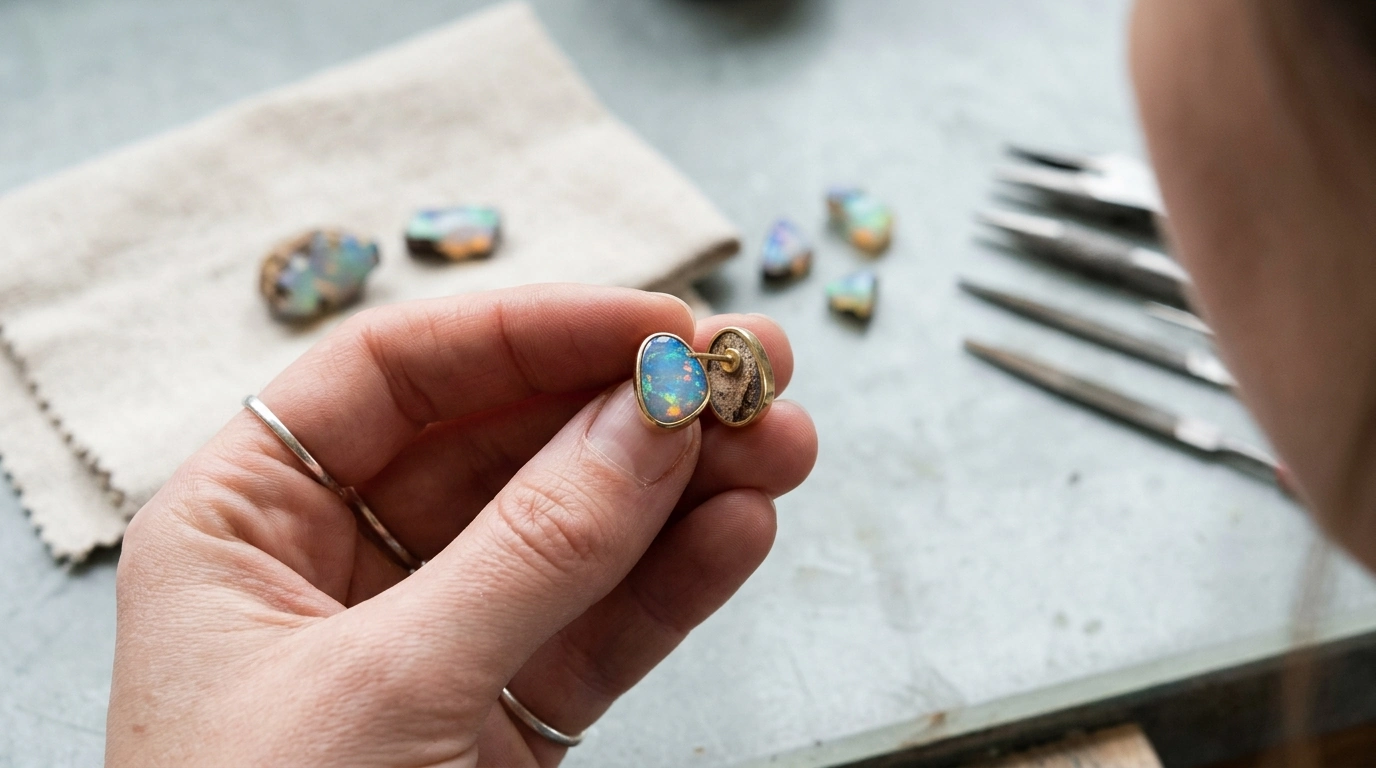
Start with the way the color appears in the stone. Many natural opals show “play-of-color”: flashes that shift as you tilt the earrings under a light. The pattern may look different from one stud to the other, and the flashes can seem to come from within the stone. A perfectly repeated pattern on both earrings, especially one that stays the same from every angle, is a reason to ask what the stones are made of.
That visual test is only a starting point. Some genuine opals have little or no play-of-color, while synthetic opals can display vivid flashes. Appearance alone cannot reliably establish whether an opal is natural, lab-created, assembled, or an imitation.
If the setting leaves an edge visible, look for distinct layers. An opal doublet has a thin layer of opal bonded to a backing; a triplet also has a clear protective cap. Both contain real opal, but they are not solid opal stones. A solid opal should not have those assembled layers. An opaque setting may hide the edge, so the absence of a visible seam proves little.
Natural stones often differ slightly in their color pattern. Identical-looking patterns can suggest a manufactured material, although matching color and overall appearance is normal in a thoughtfully paired set. Do not scratch, heat, or soak an earring to test it; those methods can damage the stone or its setting.
Ask for a clear description of the stone: natural solid opal, lab-created opal, doublet, triplet, or imitation. “Real opal” can be too vague to tell you which one you are getting. For an expensive pair, documentation from a qualified gemologist can provide more confidence than a home inspection.
Also confirm the metal used for the posts and backs, particularly if your ears are sensitive. A “925” mark identifies sterling silver, not the opal. For everyday wear, choose secure backs and handle the earrings gently: opal is more vulnerable to knocks than many common jewelry stones. For styling and care ideas, explore our guide to opal stone sterling silver stud earrings.
A brief splash is not necessarily a problem, but we recommend removing opal earrings before swimming, showering, or using cleaning products. Prolonged exposure to water is especially best avoided for doublets and triplets because moisture can affect their bonded layers.



Leave a comment