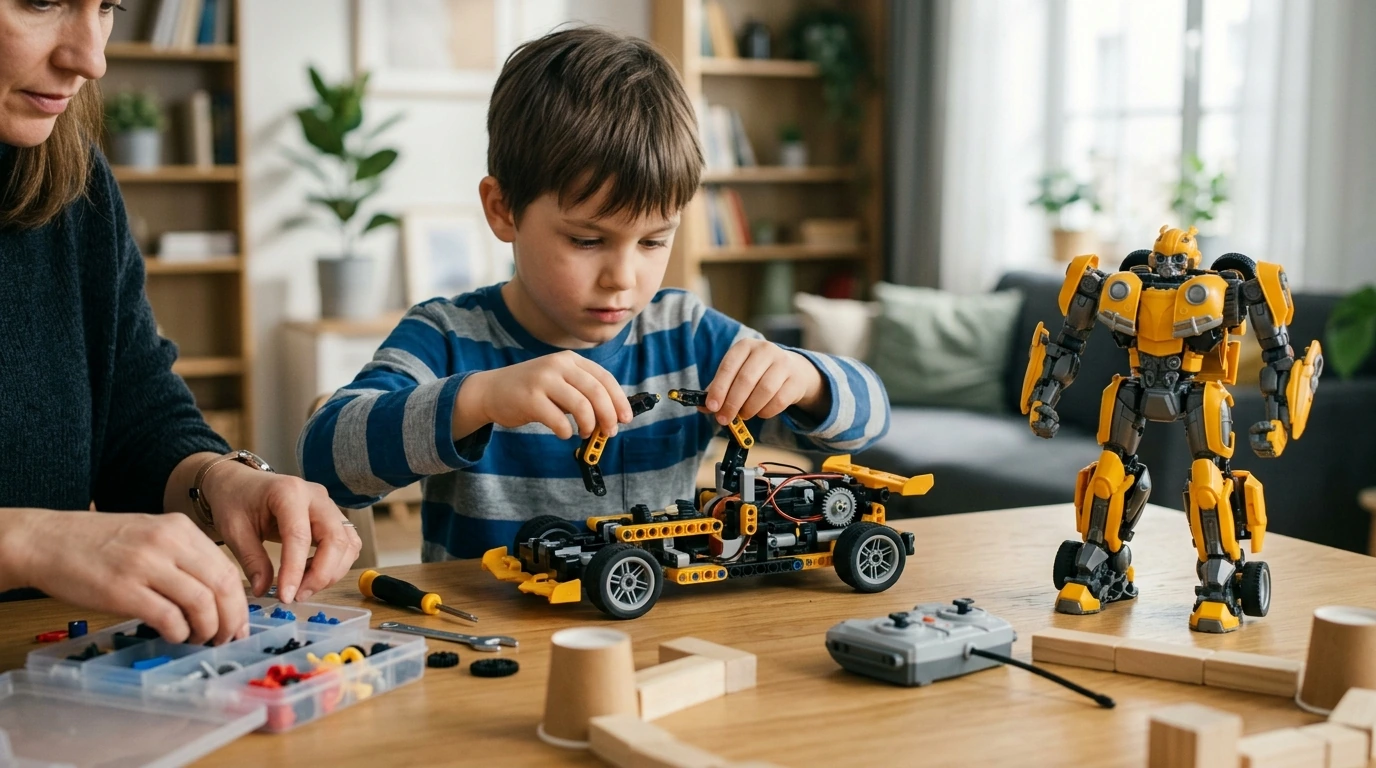
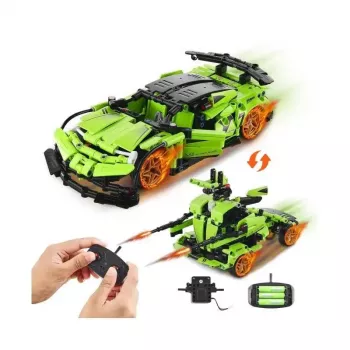
A 2-in-1 RC car and robot building kit combines the satisfaction of constructing something from parts with the instant excitement of remote-control driving. Instead of being “done” once it’s assembled, a transforming build invites kids to tweak, rebuild, and test how different configurations change the way it moves. Below is a practical guide to what sets these kits apart, what kids practice while building, and simple ways to make the first build (and first drive) go smoothly.
Unlike single-purpose toys, a transforming kit is built around two play modes: a vehicle configuration for driving challenges and a robot configuration for imaginative missions. That dual identity adds replay value because the fun isn’t limited to one final model—it includes the process of reconfiguring.
Transformation also encourages iteration. Kids can see, in real time, how changing structure affects balance, turning behavior, and stability. If the build feels wobbly or doesn’t roll cleanly, that becomes a clue to re-check alignment, symmetry, and connection points—exactly the kind of trial-and-adjust thinking that makes hands-on building so engaging.
This style of kit is designed for hands-on assembly, supporting step-by-step building and basic troubleshooting. The transforming concept keeps the experience fresh: switch between car mode and robot mode when kids want a new “mission,” a new look, or simply a new challenge.
Remote-control play adds satisfying cause-and-effect learning. Steering inputs, turning radius, and speed control become part of the play pattern—not just “go fast,” but “go precisely.” For families, it also works well as a cooperative build: one person sorts parts and reads steps while another assembles and checks fit.
If you want current details and availability, see the product page: 2-in-1 RC Car & Robot Building Kit for Kids.
For parents who like to connect play with broader STEM curiosity, resources such as IEEE TryEngineering and NASA STEM Engagement can provide age-appropriate extensions and activity ideas.
Difficulty is less about the number on the box and more about how the kit “feels” in a child’s hands. For younger builders, clearer instruction steps, larger parts, and fewer tiny connectors reduce frustration. For older kids, more complex builds can be more satisfying—especially when the transformation requires meaningful reconfiguration rather than a simple flip.
A good match feels challenging but achievable within a few sessions, not overwhelming in the first 10 minutes. If attention span is a concern, plan stages: sort parts first, build the chassis next, assemble the drivetrain, then complete the transformation steps. Short “wins” along the way keep motivation high.
This comparison can help match the kit to a child’s play style. Transforming kits tend to emphasize rebuilding and experimentation, while single-mode toys often emphasize instant play. The sweet spot is a balance of build time and drive time—both should feel rewarding.
| Feature | 2-in-1 RC Car & Robot Building Kit | Typical Single-Mode RC Car | Typical Basic Robot Build Kit |
|---|---|---|---|
| Primary experience | Build + transform + drive | Drive immediately | Build + simple motion |
| Replay value | High (rebuild into another form) | Medium (tracks, stunts, races) | Medium (repeat the same build) |
| Learning focus | Mechanics + spatial reasoning + iteration | Control skills + coordination | Assembly + basic mechanisms |
| Best for | Kids who like constructing and reconfiguring | Kids who want fast action with minimal setup | Kids who like building but prefer one stable model |
| Parent involvement | Helpful for sorting parts and checking steps | Low | Moderate |
During operation, keep hair, loose clothing, and cords away from moving wheels and gears. A quick wipe of wheels and moving parts after floor play can also help maintain performance. For general toy-safety guidance, consult the American Academy of Pediatrics toy safety tips.
For gift-giving, it’s a strong option when a longer-lasting activity is preferred over a one-time novelty toy. Transforming themes also pair naturally with imaginative roleplay: explorer, rescue robot, delivery driver, and more. If you’re bundling a celebration gift, a small add-on keeps the moment special—consider a keepsake like a Personalized Letter Necklace to complement the main build.
It depends on the child’s age, the clarity of the instructions, and how many small connectors the kit uses. Splitting the build into stages and offering light adult help for sorting and alignment usually makes the first experience much smoother.
Many builds fall in the 30–120 minute range depending on complexity and experience. Breaks help, and doing a quick functional test before adding final decorative pieces can prevent time-consuming rework.
Use small containers or segmented trays, and keep subassemblies grouped together. Store the partially built model and remaining parts in the same lidded box so everything stays in one place between sessions.

Leave a comment